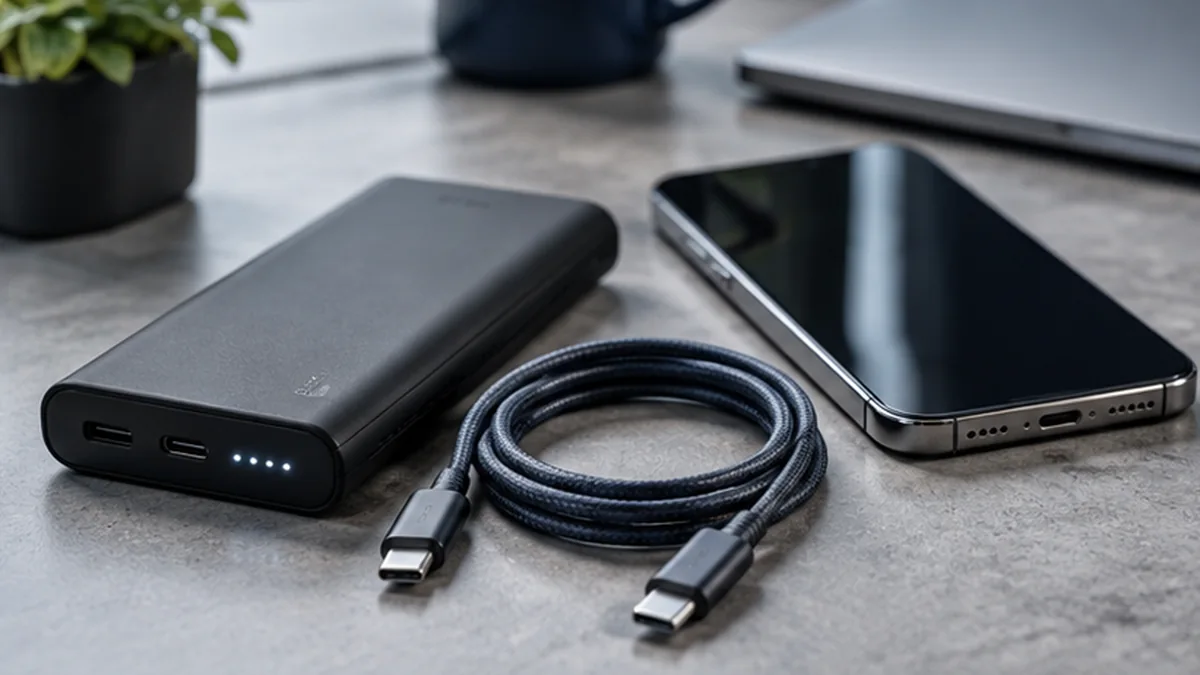
Start with a USB-C Power Delivery output, a suitable cable and a documented rated power. Check what the power bank can deliver at its USB-C port, not just its advertised peak combined wattage.
Guide
Power bank for iPhone Duo: what really matters
Capacity is only part of the story. USB-C PD, weight, form factor and reliable magnetic alignment matter just as much in daily use.
Quick answer: USB-C power bank or Qi2 magnetic battery?
Choose a USB-C Power Delivery power bank if efficient charging and broad device compatibility matter most. A Qi2 magnetic model may be convenient for short top-ups, but it must align properly and not obstruct the folding hinge or intended grip. A larger number of milliamp-hours does not guarantee a precise number of iPhone Duo recharges: compare watt-hours, output limits and conversion losses, not just the packaging headline.
| Priority | What to look for |
|---|---|
| Short commute | Low weight, one practical USB-C output and manageable cable storage. |
| Navigation or long travel day | Adequate capacity in Wh, a documented USB-C PD output and suitable heat management. |
| Cable-free convenience | Verified Qi2 certification and explicitly documented phone/case alignment. |
| Air travel | Readable Wh rating and your carrier's up-to-date lithium battery policy. |
Apple confirms MagSafe and Qi2 charging support for iPhone Duo; that does not certify every third-party power bank. For a specific product, consult the Wireless Power Consortium database, the Apple product announcement and, before flying, IATA battery guidance.
Choose the charging method before the capacity
Check actual Qi/Qi2 certification using the exact accessory model. Then check attachment, camera and hinge clearance; magnetic alignment alone is not evidence of safe fit or efficient charging on a foldable.
Look at watt-hours (Wh), not simply mAh. Airline and route rules can vary; check them before you pack. Do not equate a nominal cell capacity with a guaranteed count of full iPhone Duo charges.
Verify: WPC certification database and IATA's passenger battery guidance. No recharge benchmark or charging-speed test has been performed for a named product.
Balance capacity against weight
Large power banks offer more reserve but quickly become heavy. A smaller model can be better for daily carry, while larger capacity may make sense for travel.
- Support USB-C PD
- Provide appropriate output power
- Choose Qi2 only if magnetic charging is useful to you
- Check airline rules before flying
Cable or magnetic charging?
USB-C is efficient and often faster. Magnetic charging is more convenient but can create more heat and may charge more slowly depending on conditions.
Form factor matters with a foldable
A magnetic battery should not interfere with the hinge or make the device uncomfortable to hold. Compact designs are especially relevant here.
Capacity explained: mAh is not the delivered charge
The mAh value printed on a power bank usually refers to its internal cells, not all the energy that reaches the phone. Voltage conversion, cable losses and wireless charging reduce what is actually delivered. Watt-hours (Wh), supported USB-C output and charging behaviour therefore tell you more than capacity alone. Without reliable measured results, a precise number of full iPhone Duo charges would be guesswork.
- USB-C: check Power Delivery support and the stated output rating.
- Cable: make sure its capability matches the charging setup.
- Wireless: verify Qi2/MagSafe support and alignment for this device.
- Air travel: check the Wh marking and the airline's current battery rules.
Three sensible use cases
For a short commute, a light emergency top-up can be more useful than carrying a large battery. A long day of navigation or travel may justify more capacity, provided the weight is acceptable. If you plan to charge several devices, check the combined output: individual port ratings may not apply simultaneously.
A USB-C cable is generally the straightforward option when energy efficiency matters. A magnetic power bank can be convenient, but its shape must not obstruct the hinge or interfere with an open configuration. Treat compatibility as unconfirmed unless the accessory maker documents the exact device or fitting conditions.
Further reading: USB-IF – Power Delivery ↗ · IATA – flying with power banks ↗. Check current airline rules and product compatibility separately.
Frequently asked questions
How much capacity do I need?
That depends on whether you want an emergency top-up or multiple recharges. Higher capacity almost always means more weight.
Is Qi2 better than USB-C?
Not inherently. Qi2 is more convenient, while USB-C is usually more efficient. A power bank supporting both can be a practical compromise.
Choosing a power bank: a practical checklist
A power bank’s advertised capacity is not the amount of energy delivered to a phone. Conversion losses occur during charging. Compare the watt-hour rating, supported output modes and charging method as well as milliamp-hours. Actual results also depend on usage, temperature and battery condition.
- Wired charging: Look for USB-C Power Delivery and a suitable cable. The presence of a USB-C socket does not prove support for every charging profile.
- Magnetic charging: If a product advertises Qi2, verify the specific certification and whether it aligns correctly with any case or stand you use. Wireless charging may produce more heat.
- Travel: Size, weight and the watt-hour rating can matter more than maximum advertised capacity. For flights, always check your airline’s current battery rules and applicable regulations.
Test a power bank on an ordinary day before relying on it during a long trip. Assess real charging progress, heat and convenience rather than translating advertising claims into a guaranteed number of phone charges.
Separate USB-C output from wireless claims
For wired charging, check USB Power Delivery, cable suitability and the power bank’s rated output. For magnetic charging, also check alignment, certified Qi/Qi2 support and heat management. The printed cell capacity in mAh is not the amount delivered to the phone after voltage conversion and charging losses. Without measured efficiency and the specific phone battery configuration, claiming an exact number of recharges would be misleading.
Verifiable source: Apple: using USB-C on iPhone