Ask the mount maker for compatibility with iPhone Duo in its chosen folded position, including any case. A generic “MagSafe compatible” label is not proof of a mechanically secure hold.
Guide
iPhone Duo in the car: choosing the right mount
With a foldable, magnet strength is not enough. Weight, leverage and hinge position all affect how stable a car mount feels in daily use.
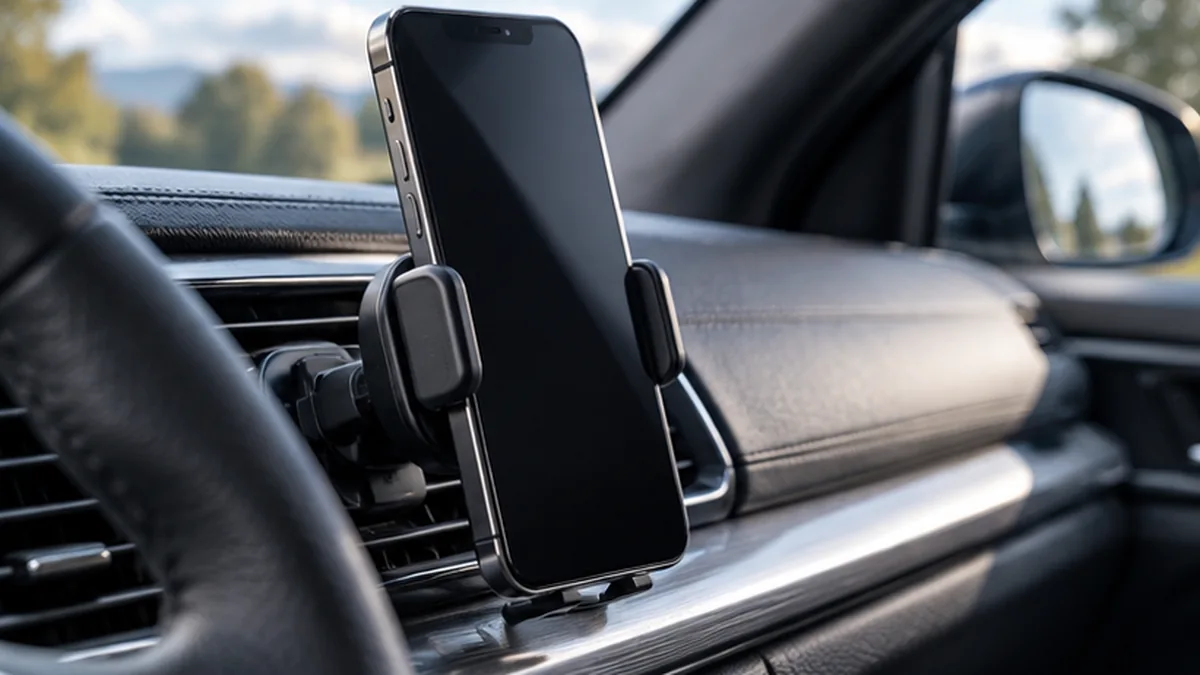
Quick answer: which iPhone Duo car holder should you choose?
For a foldable phone, a secure mechanical cradle is a reasonable starting point when a mount maker has not documented compatibility with the exact iPhone Duo and its case. A magnetic charging mount can be convenient, but Qi2 certification checks wireless charging interoperability, not how firmly a holder stays attached to a car. Avoid claiming that a product has been independently tested here unless its actual test results are available.
| Mount type | What to verify first |
|---|---|
| Vent car holder | Vent strength, access to controls and whether warm air reaches the phone. |
| Dashboard or suction mount | Mounting surface, unobstructed sight lines, airbag clearance and joint stability. |
| MagSafe or Qi2 charging mount | Exact model and case fit, physical retention, charging certification, power source and heat. |
While parked: fit the holder, gently check both closed and opened configurations only where the mount maker permits them, and make sure the handset cannot shift toward controls or sight lines. Never adjust the phone while driving.
Primary references: Apple iPhone Duo announcement and the Qi-certified product database. Neither is a validation of a particular third-party car holder.
Choose the holder in three steps
Check visibility, screen distraction, mounting stability and cable clearance with the vehicle parked. Do not assume a flexible air-vent clip suits every vent or supports a folded-out device.
If wireless charging is included, match the exact charger model to the Wireless Power Consortium certified-product database. Certification covers defined charging properties, not the holder's hinge clearance or grip.
Source boundary: Apple describes the iPhone Duo foldable design; WPC explains how to verify a Qi-certified model. No particular third-party car mount has been independently road-tested here.
Stability comes first
The device's weight distribution can change with the opening angle. A suitable mount should therefore be rigid and have very little play.
- Stable base or firm vent clamp
- Correct magnetic alignment
- Charging should not create excessive heat
- The position must not obstruct visibility or controls
Charging mount or passive mount?
A Qi2- or MagSafe-compatible mount reduces cable clutter. Drivers who use navigation frequently can benefit from dependable power while mounted.
Use it open or closed?
A closed, compact configuration is usually easier to stabilise in a car. Open use should only be considered when the mount and position are clearly suitable for it.
Five checks before choosing a mount
A MagSafe label on its own does not establish that a car mount is suitable for a folding phone. Start with the installation point: a movable air vent, a fixed dashboard bracket and an adhesive pad all distribute weight differently. The arm and ball joint must remain rigid when the device changes orientation, and the mounting material must suit the temperatures found inside a parked car.
- Placement: keep the windscreen view, vehicle controls and airbag zones clear.
- Load rating: verify the manufacturer's rated weight and joint strength.
- Magnets: look for documented compatibility with the exact phone and case.
- Charging: check the wireless standard and the power source separately.
- Access: make sure the device can be removed safely without distraction.
A useful test while parked
Fit the mount while the vehicle is stationary. Place the phone in the configuration you plan to use and check the viewing angle, hinge clearance and whether the joint moves under a gentle hand check. Make sure the display does not encourage interaction while driving. A large screen is not worth a blocked view or awkward controls.
If the mount also charges wirelessly, monitor heat and charging interruptions on a longer journey. Unusual heat, sliding alignment or an unstable support are reasons to stop using that combination. Where exact iPhone Duo compatibility has not been documented, an adjustable mechanical cradle can be a safer starting point than assuming that any magnetic mount will work.
Technical background: Wireless Power Consortium – Qi2 certification ↗ · Apple Support – MagSafe alignment ↗. These resources describe charging principles, not approval of a particular car mount.
Frequently asked questions
Will any MagSafe mount work?
Not automatically. The weight and form factor of iPhone Duo can place greater demands on magnet strength and joint stiffness.
Vent or dashboard mount?
It depends on the vehicle. The key is secure attachment, good visibility and safe clearance from controls and airbags.
Before you drive: test more than magnetic grip
When a foldable device is opened, its centre of gravity can change. A strong magnetic surface alone may not prevent leverage on the mount arm. Check the mount with the car stationary and in the screen configurations you actually plan to use.
- Visibility and airbags: Keep the mount clear of important sight lines and airbag deployment areas. Check local rules and your vehicle manufacturer’s advice.
- Mounting surface: Vent, dashboard and suction mounts can fail in different ways. Check whether the mount moves when gently touched and whether controls remain accessible.
- Cable and temperature: Route charging cables without tension or contact with controls. Direct sunlight or hot air from vents can contribute to warmer charging conditions.
A sensible everyday check includes several controlled entries and exits, a clear view of the screen and a second inspection of the mount’s fasteners. This practical procedure is not a substitute for the device and mount makers’ compatibility statements.
Certification, magnetic alignment and fit are different checks
A certified wireless charger is not automatically approved for every handset shape or hinge position. Look up the exact accessory model in the Wireless Power Consortium product database, confirm the mount maker’s device compatibility and check physical retention with the vehicle parked, both folded and unfolded. A magnetic alignment claim alone does not prove secure mechanical support for a large folding phone.
Verifiable source: Wireless Power Consortium certified-product database